Start with the kind of voice application you need
This guide covers software for interactive voice agents: applications that listen, respond and use tools during a conversation. A text-to-speech generator for recorded narration solves a different problem, so a list of attractive voices alone will not help you choose a telephone or browser agent stack.
We selected six options spanning configurable platforms and developer frameworks, then compared their documented responsibilities and pricing structure. We did not run the same audio benchmark across these products, and we do not award speed, reliability or voice-quality scores without that evidence.
APIFleet publishes this guide and is included in the shortlist. Treat our recommendation as a starting point for your own pilot; ask competing vendors the same questions about costs, limits, operations and the exact route you intend to use.
| Tool | Consider it when | Check before choosing |
|---|---|---|
| APIFleet | You want a configurable voice-agent platform with customer-owned provider keys | Provider and carrier charges sit alongside the platform fee; test your actual integration |
| Vapi | You want a hosted platform with a model catalog and usage-based hosting | Hosting, model usage and optional support packages have different billing boundaries |
| Retell AI | You want a managed phone-agent platform with an itemized pricing calculator | Configure the exact voice, model, telephony and add-ons before comparing totals |
| ElevenLabs Agents | You want to evaluate ElevenLabs' conversational-agent stack | Check the agent plan and tool workflow; a TTS-only quote is not an agent quote |
| LiveKit Agents | Your team wants to build agent behavior in code around realtime media | Choose cloud or self-hosted deployment and account for the operational work |
| Pipecat | Your team wants a Python pipeline with control over its components | Decide who will host, monitor and maintain the pipeline and its integrations |
Compare managed platforms by their billing boundaries
APIFleet charges a $0.03 platform fee per connected AI minute, billed per second, plus provider and carrier usage. Prepaid funding starts at $10, with no subscription or free credits; when you supply your own provider keys, those providers bill your account directly.
Vapi's pricing page lists $0.05 per minute for hosting on its usage-based option, with model costs passed through separately. It also lists optional support packages, so record which package your comparison assumes instead of treating every Vapi customer as having the same fixed bill.
Retell's pricing page advertises an AI voice-agent range of $0.07 to $0.31 per minute and provides separate selections for the model, voice, telephony and add-ons. That advertised range and a platform-only fee describe different bundles; use the configured total for your workload before drawing a cost conclusion.
At 10,000 connected AI minutes, APIFleet's platform fee is $300 and Vapi's listed hosting fee is $500 before other charges or discounts. The $200 difference is arithmetic on those two fee components, not a promise that the complete APIFleet deployment costs 40 percent less.
Separate voice selection from control of the whole stack
ElevenLabs documents a conversational-agent product alongside its audio products. Include that agent product in your evaluation if it fits your workflow, and verify the required tool integrations and telephone route rather than assuming that a convincing voice sample proves the entire application will work.
LiveKit Agents is an open-source framework with realtime media, model integrations and agent lifecycle components. Its documentation describes both LiveKit Cloud and self-hosted connections; choosing a framework gives your engineers more implementation responsibility than simply configuring an assistant in a managed dashboard.
Pipecat documents an open-source Python framework, client SDKs and managed hosting options. It is worth evaluating when you need to compose a pipeline and own its behavior, but a free framework license does not cover inference, carrier usage, hosting or the time spent operating it.
Make ownership explicit before comparing these categories. Name the person who will investigate a dropped call, a failed tool request or an unavailable model, and decide what evidence they will have when that incident occurs.
Use one pilot scorecard for every shortlisted tool
Choose one representative task, such as checking availability and requesting an appointment with test data. Define success as the correct downstream result, then keep the caller script, language, destination region and expected handoff behavior consistent across candidates.
Measure the full route you plan to ship. A browser demo can help check configuration, but it does not establish the behavior of your carrier route, audio encoding or telephone connection; report those contexts separately in your notes.
The following checklist is an evaluation design, not a report of tests we ran on these products. Use it to produce your own comparable evidence before committing a budget or moving a live number.
- Write down the task, test language, connection type and the backend record that proves success.
- Run an ordinary conversation, an interruption, an ambiguous request and a deliberately failed tool response.
- Inspect the transcript, tool result and downstream record together; count an incorrect confirmation as a failure.
- Record connected AI seconds and all charge components, including carrier time after a handoff where applicable.
- Divide the complete test cost by successfully completed tasks, and review failure examples alongside that number.
- Keep the working configuration and a rollback route before moving a small amount of production traffic.
Choose for your workload, then refresh the evidence
Shortlist APIFleet when provider ownership, a separate platform tariff and a configurable workspace match how your team wants to operate. Consider another managed platform when its documented workflow or service package better matches your requirements, and a framework when your engineers need deeper control and can support it.
Keep the publication date separate from your buying decision. This page looks ahead to 2027 using information available in October 2026; verify current prices, product limits and plan terms again when you run your pilot, rather than treating the year in a title as evidence of freshness.
Start with the free cost calculator to make your assumptions visible, then use the integration and comparison pages to narrow the test. The useful outcome is a stack you can operate with a measured cost per completed task, not the largest number of features in a table.
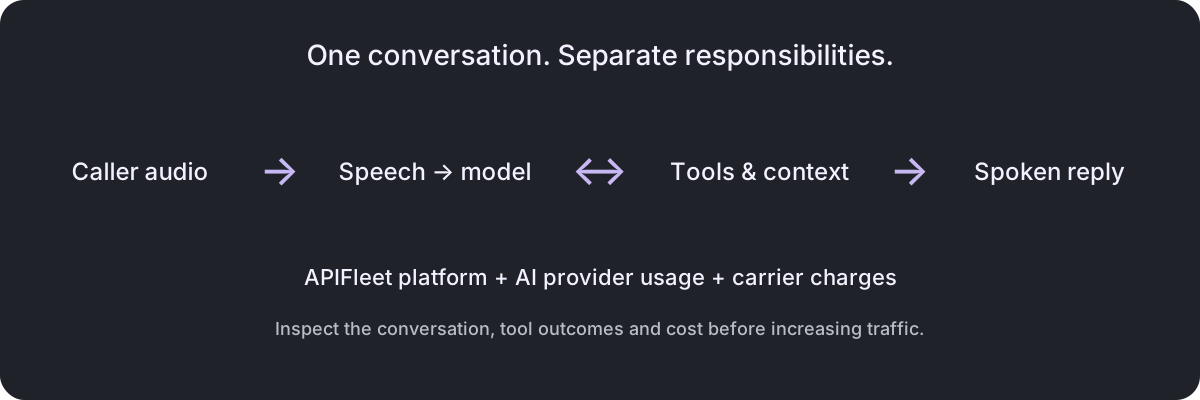
Continue with a practical next step
Frequently asked questions
Have these tools been tested for performance in 2027?
No. This is a forward-looking planning guide based on documentation checked on 28 October 2026. It does not claim future availability, future prices or measured comparative performance.
Is APIFleet's $0.03 price the complete cost per minute?
No. It is the platform fee per connected AI minute, billed per second. Provider and carrier charges are additional; customer-owned provider keys are billed directly by those providers.
Should I use a managed voice platform or a framework?
Compare the operational work as well as usage costs. A framework makes sense when your team needs implementation control and can maintain the stack; a managed platform may fit when you want more of that infrastructure provided.
Sources and evidence
- APIFleet pricing and billing boundaries · observed 2026-10-28
- Vapi pricing: hosting, model costs and support packages · observed 2026-10-28
- Retell AI pricing and configuration calculator · observed 2026-10-28
- ElevenLabs Agents overview · observed 2026-10-28
- LiveKit Agents introduction · observed 2026-10-28
- Pipecat ecosystem documentation · observed 2026-10-28