Start with three separate costs
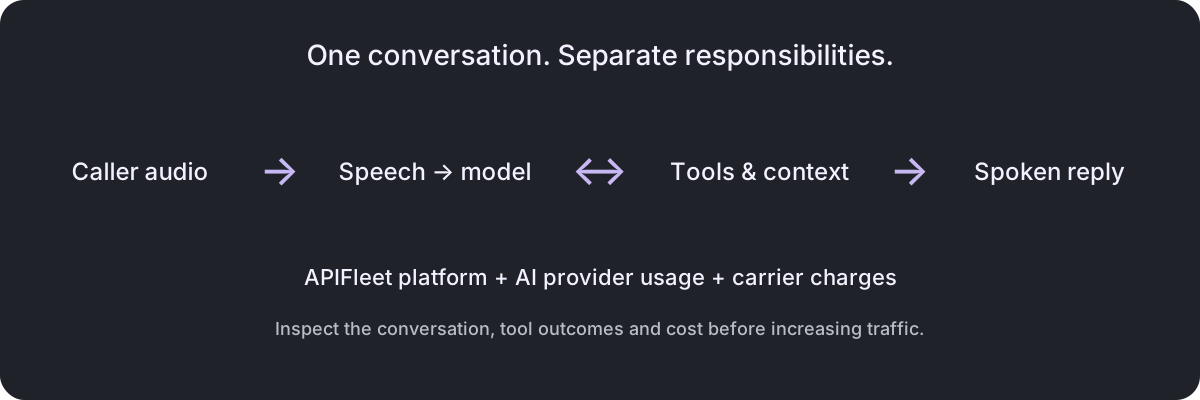
A voice call usually combines a platform, AI services and a telephone connection. Vendors package those pieces differently. One headline rate may cover orchestration alone; another may include transcription, a model and a voice. Put each quote into the same categories before comparing it.
- Platform
- Running and coordinating the assistant. APIFleet charges $0.03 per connected AI minute, billed per second.
- AI providers
- The model, transcription and generated speech. Usage may be measured in tokens, audio duration or characters rather than call minutes.
- Telephone carrier
- The connection to the telephone network. Account for the destination, direction, number rental and any separate call legs.
A browser conversation has no telephone-network leg, but it still uses the platform and AI services. A call transferred to a person may continue accumulating carrier costs after the AI portion ends.
Work through one call
Assume an illustrative call has exactly 60 connected AI seconds, $0.0400 of AI provider usage and $0.0100 of carrier usage. These are example inputs, not a quote for a particular model, voice or destination.
| Component | Cost |
|---|---|
| APIFleet platform | $0.0300 |
| AI providers | $0.0400 |
| Carrier | $0.0100 |
| Combined cost | $0.0800 |
If APIFleet funds the AI providers, the platform and recorded provider usage at configured rates settle against your prepaid balance. Customer-owned provider keys are paid directly to those providers and are not billed a second time by APIFleet. Your carrier account is paid separately. The combined cost is therefore not necessarily one invoice.
For 90 connected AI seconds, the platform portion is $0.0450. Do not assume the other components rise in exactly the same proportion: model context, speaking time and carrier rounding can differ.
Turn calls into a monthly estimate
Multiply expected connected AI minutes by the platform rate, then add provider and carrier estimates from representative calls. At 10,000 connected AI minutes, APIFleet’s platform portion is $300. That figure excludes AI providers and telephony.
Use a mix of short questions, normal conversations, long calls and transfers. A single successful demo rarely represents production traffic. Keep separate assumptions for call volume, average duration, model context and how much the agent speaks.
For subscription alternatives, include the monthly fee, unused included minutes and overage charges. For a framework you host yourself, add compute, idle capacity and the engineering work required to operate it.
Ask the same questions of every quote
- Which speech and model services are included, and which are added later?
- Does billing round each call, each component or the total usage?
- What happens during silence, transfers and unsuccessful calls?
- Are analysis, recording, numbers or support separate charges?
- Who pays each provider when customer-owned credentials are used?
Our comparison directory separates published platform rates from bundled and quote-based offerings. For a close orchestration-fee comparison, see APIFleet vs Vapi.
Treat prepaid funding as a budget control
APIFleet has no monthly subscription or free credits. The minimum top-up is $10. Calls reserve funds while they run; unused reserved funds return to the available balance when the call settles. A hold is not an extra fee.
Keep enough available balance for concurrent calls and watch provider accounts that you fund directly. A prepaid platform balance does not cap a separate carrier or model account. Review actual call costs before increasing traffic, and keep estimates separate from provider invoices.
Continue with a practical next step
Sources and evidence
- APIFleet product and pricing · observed 2026-10-19
- APIFleet API documentation · observed 2026-10-19