At a glance
Compare the scope of each rate before comparing the number. All amounts below are USD.
Scroll across the table to see both platforms.
| What matters | APIFleet | Pipecat |
|---|---|---|
| Starting point | $0.03 per connected AI minute Platform fee, billed per second | $0.01 / active min Pipecat Cloud agent-1x hosting only |
| Payment model | Prepaid usage. $10 minimum top-up. No monthly subscription or free credits. | The framework is open source. Cloud hosting charges for active and reserved capacity. |
| Cost scope | AI providers and carrier charges are additional. Customer-owned keys are paid directly to providers. | Cloud agent-1x active compute is $0.01 per minute; reserved capacity is $0.0005 per minute. Transport and AI services are separate. |
| Working style | Configurable assistants, tools, knowledge, browser tests, simulations and call logs. | Python pipelines connect AI services, audio processing and transports. |
Compare a framework build with a managed workspace.
Pipecat gives an engineering team control over the conversation pipeline. Its hosting price should be compared with hosting, not treated as a full call bill. Add provider usage, transport and the work of building configuration, logs, credentials and deployment around your agent.
When Pipecat may fit
Evaluate Pipecat when custom pipeline behavior is central to the product and your team wants to own the Python implementation and its operations.
When APIFleet may fit
Evaluate APIFleet when the immediate need is operating configurable agents through an existing dashboard and API with built-in tools, simulations and call logs.
APIFleet currently limits new workspace access. Existing users can sign in; contact us about a new project. Carrier accounts, standalone previews, file transcription and simulation caller/judge models require customer-owned credentials.
Two workloads to price explicitly
These hypothetical examples assume exactly 1,000 or 10,000 connected AI minutes. They calculate APIFleet’s platform portion only; model, speech, carrier, numbers and any other service charges must be added.
| Workload | APIFleet platform arithmetic | Pipecat estimate |
|---|---|---|
| Pilot: 1,000 minutes | 1,000 × $0.03 = $30.00 | Apply the vendor’s published or quoted terms to the same provider stack and duration. |
| Operation: 10,000 minutes | 10,000 × $0.03 = $300.00 | Include subscriptions, allowances, overages, rounding and implementation work when applicable. |
A bundled vendor rate cannot be compared directly to the APIFleet platform portion. We do not infer Pipecat’s concurrency or seat limits from a minute rate; confirm them for your planned workload.
Run a one-assistant switching pilot
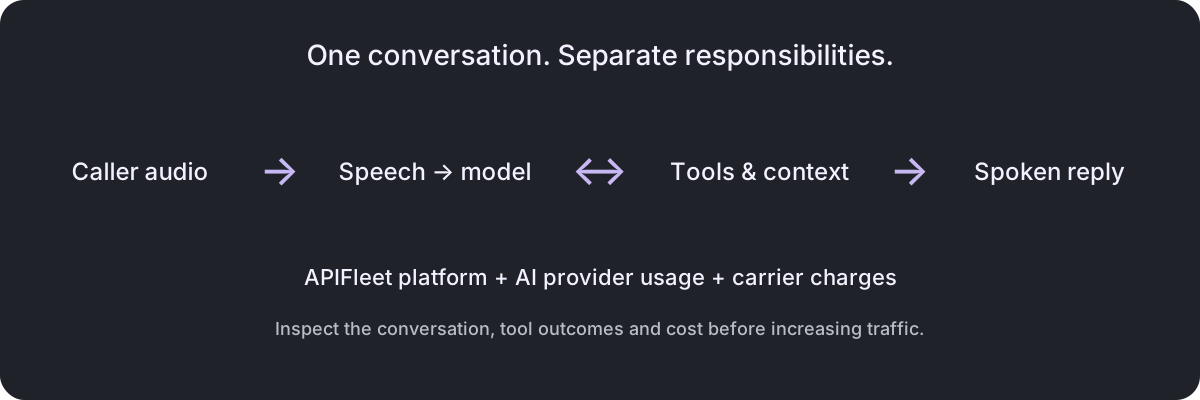
Before switching from Pipecat, recreate one assistant, replay its tool requests, test interruptions and transfers, then move one controlled route with a written rollback. Use the voice-agent migration checklist and conversation test plan with the vendor-specific checks below.
What to test before switching
- Measure reserved capacity even when no calls are active.
- List the management and observability tools your application needs.
- Prototype custom processors and compare ongoing maintenance work.
There is no universal one-click import. Map prompts, tools, credentials and routing explicitly, then run controlled calls. Our gradual migration guide gives you a sequence with a rollback boundary.
Sources & review
Official vendor pages checked on . Pipecat Cloud pricing · Pipecat framework.
This is APIFleet’s assessment, not an independent benchmark or an endorsement by Pipecat. Prices and packaging can change. Confirm the current terms and test your intended configuration before committing.